




















2026 Working Days
How Many Working Days In 2026?
If you’re mapping out projects, staffing, payroll, or accounting, one of the first questions that comes up is: how many working days are there this year? Knowing this helps you estimate budgets, hours, and working hours, set realistic deadlines, and schedule vacation and sick leave. In the US, for example, the answer depends not only on the calendar itself, but also on federal holidays, observed holidays, and whether you’re excluding weekends.
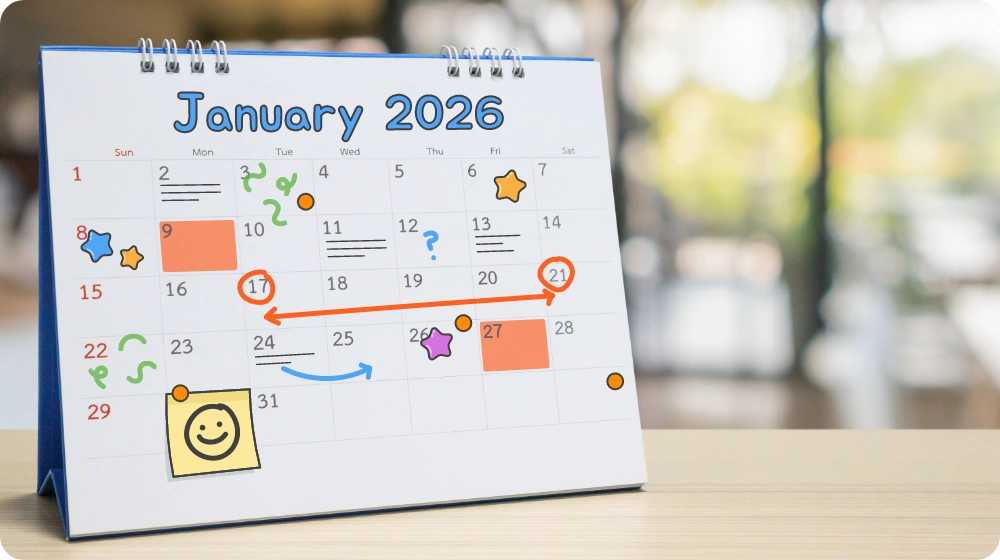
Below is a complete, practical guide to understanding working days in 2026, along with how to calculate business days between two dates, what counts as non-working days, and why the total can vary slightly depending how your organization observes time off.
2026 at a glance: days, weeks, weekdays, weekends
First, let's look at the structure of the calendar year.
- 2026 is a common year, not a leap year
- There are 365 total days in 2026
- There are 52 full weeks plus one extra date
- There are 261 weekdays and 104 weekend days
Because 2026 is a common year, the number of days is 365. If you're wondering how many days fall on each day of the week:
- Monday through Friday (the typical Monday to Friday or ‘Mon-Fri’ schedule): 261 total workdays
- Saturday and Sunday represent 104 total weekend days
This 261 figure represents how many weekdays occur in the entire year before we subtract public holidays.
The short answer: how many working days in 2026?
If you take:
- 261 total weekdays in 2026, and
- Subtract the 11 major US public holidays that fall on or are observed on weekdays,
You are left with approximately 250 working days for a standard US Monday to Friday schedule.
So if you are asking:
- How many working days are in 2026?
- How many business days are in 2026?
- How many work days or how many workdays in a typical American year?
The headline answer for 2026 is:
250 working days (business days), excluding weekends and federal holidays.
This is the final calculation most planners use.
However, your workplace total can vary slightly depending:
- Whether your organization observes additional official holidays
- Company-specific or country specific holidays
- Personal paid time off policies
- State-level public holidays
- How a holiday falls (for example, on sunday or saturday and is observed on a weekday)
- Whether you include sick leave and vacation days as non working days
So treat 250 as the standard reference point for the United States.
Federal holidays in 2026 (and how they reduce working days)
When counting business days or workdays, the United States usually subtracts the major federal holidays. In 2026, those include:
- New Year's Day - January 1
- Martin Luther King Jr Day - third Monday in January
- Washington's Birthday (Presidents Day) - third Monday in February
- Memorial Day - last Monday in May
- Juneteenth National Independence Day - June 19
- Independence Day - July 4 (observed when the holiday falls on a weekend)
- Labor Day - First Monday in September
- Columbus Day - Second Monday in October
- Veterans Day - November 11
- Thanksgiving Day - Fourth Thursday in November
- Christmas Day - December 25
Because Independence Day in 2026 falls on a Saturday, the observed day off occurs on Friday for many employees and employers. That observed day counts as one of the non-working days for much of the federal workforce and for many private employers, although observance rules can vary.
Why your exact number might be different
The exact number of working days you or your team experience may not be 250. Here’s why your total can vary slightly depending your situation:
- Your country (if you use this method outside the US)
- State or city-level public holidays
- Religious or company official holidays
- Floating holidays offered by employers
- Individual vacation and sick leave
- Whether you count observed holidays when a holiday falls on a weekend
- Whether your schedule isn’t traditional Monday to Friday
That’s why it’s useful to know both the standard US total and how to calculate between any start date and end date.
How to calculate business days between two dates in 2026
Sometimes you don’t just need the entire year, you need to know the duration between two dates, such as project start and end dates.
To calculate business days, you:
- Choose a start date
- Choose an end date
- Count weekdays (Monday, Tuesday, Wednesday, Thursday, Friday)
- Subtract weekends (Saturday and Sunday)
- Subtract holidays occurring in that interval
A working days calculator can automate this process. Often these tools let you simply enter your start date and end date, and the tool will calculate the number of working days, highlight weekends, and remove holidays for you.
This is especially useful for payroll periods, project planning, or accounting timelines.
Example: Counting working days in a specific month of 2026
Here is a quick example looking at January 2026.
- There are 31 total number of days in January
- The start date is Thursday, January 1
- There are 23 weekdays
- There are 8 weekend days
- There is 1 major federal holiday (New Year’s Day)
- So there are roughly 22 working days in this month
Repeat this type of calculation method month-by-month if you’re interested in detailed totals or want to plan payroll or staffing schedules.
Working days vs working hours
Full-time employees in the US often work about 40 working hours per week, generally Monday to Friday. If there are about 250 working days in 2026:
- 250 working days × 8 hours per day ~= 2,000 working hours annually
Again, this will vary slightly depending on:
- Shift work
- Compressed workweeks
- Holidays
- Vacation
- Sick leave
- Overtime arrangements with employers
Public versus private sector: who observes which holidays?
In the United States, federal holidays are legally observed for federal government employees. However:
- Private employers are not required by federal law to observe all holidays
- Many do offer paid or unpaid time off for major public holidays
- Others substitute with floating or flexible paid time
This means the number of working days you personally experience may differ from “textbook” totals for the calendar year.
Planning projects and payroll around working days
Knowing how many workweeks and workdays occur in 2026 helps with:
- Staffing and plan capacity
- Payroll forecasting and accounting
- School and academic schedules
- Scheduling vacation blocks
- Estimating project duration
- Calculating delivery or service date commitments
Both managers and individual employees benefit from understanding the structure of business days in advance.
Key notes to remember
A quick note on terminology:
- Business days usually mean monday to friday
- Weekends mean saturday and sunday
- Non-working days include weekends and holidays
- Public holidays and official holidays reduce the number of working days
When someone asks how many business days or how many workweeks are in 2026, they’re typically asking for counts that remove weekends and holidays.
Let’s bring the pieces together for 2026 in the United States:
- 2026 is a common year, not a leap year
- There are 365 total days in 2026
- There are 261 weekdays and 104 weekend days
- Subtracting 11 major US federal holidays leaves about 250 working days
- Your own final calculation may vary slightly depending:
- observed public holidays
- additional official holidays
- company or state policies
- vacation and sick time
- whether the holiday falls on a weekday or weekend
So if you were looking for the number of Working Days In 2026:
There are approximately 250 working days in 2026, excluding weekends and federal holidays.
Whether you are a payroll professional, project manager, or just personally interested in planning your year, understanding the calendar, weekdays, and holidays gives you clarity and control over your schedule for the entire year.