
















Flowtime Technique
How to incorporate the flowtime technique into your workday
Modern work has a strange contradiction at its core. We have more tools than ever to help us be productive, yet staying focused on even one task can feel harder than ever. Notifications, shifting priorities, and constant context switching mean that deep, meaningful progress often slips through the cracks.
That’s where the flowtime technique comes in.

Unlike rigid systems that force you into predefined intervals, this more flexible method is designed to work with your natural rhythms rather than against them. It allows you to stay fully immersed in your work when your mind is ready, and take breaks when your energy dips—without guilt or arbitrary constraints.
In this guide, we’ll explore how to incorporate the flowtime method into your daily workflow, how it compares to the pomodoro technique, and how you can adapt it into a sustainable practice that actually improves your productivity over the long-term.
What is the flowtime technique?
At its core, the flowtime technique is a flexible alternative to rigid time-blocking systems like the pomodoro method. Instead of working in strict 25-minute intervals followed by a five minute break, you:
- Choose a specific task
- Record your start time
- Start working and continue until you naturally feel distracted or fatigued
- Record your end time
- Take a break based on how long you worked
- Repeat the process
This approach is built around the idea of entering a flow state—that deeply focused mental zone where your concentration is high and your output feels almost effortless.
Rather than interrupting that state with a timer, the flowtime method encourages you to stay in it for as long as it lasts.
Flowtime vs pomodoro: What's the difference?
The pomodoro technique is one of the most well-known time management systems. It breaks work into manageable chunks, typically:
- 25 minutes of work time
- A short break (often 5 minutes)
- A longer break after several cycles
It works well for building discipline and helping people stay focused, especially if they struggle to begin.
However, it also comes with time limits that can interrupt deep thinking.
The flowtime technique, by contrast, is a modified version of this idea. It keeps the structure—work, rest, repeat—but removes the rigidity.
You don’t stop because a timer tells you to. You stop because your mind tells you.
This makes it particularly effective for:
- Creative work (like when you write or design)
- Problem-solving
- Tasks that require sustained focus
Why the flowtime method works
The strength of the flowtime method lies in how it aligns with human psychology.
1. It respects your energy levels
Your energy levels fluctuate throughout the day. Some hours, you’ll feel sharp and alert. Other times, your attention drifts.
Instead of forcing yourself into fixed intervals, the flowtime technique lets you:
- Work longer when you feel strong
- Rest sooner when you feel distracted
This leads to more productive output and less fatigued work.
2. It helps you enter a flow state
When you’re fully immersed in a single task, something powerful happens: you enter flow.
In this state:
- Distractions fade away
- Your concentration deepens
- You make faster progress
Interrupting this with a rigid schedule can pull you out of that state. The flowtime technique protects it.
3. It reduces interruptions
By focusing on one task at a time and committing to it until a natural stopping point, you naturally reduce interruptions.
You’re less likely to:
- Check messages
- Switch tabs
- Jump to the next task prematurely
4. It builds awareness through tracking
A key part of the flowtime technique is to track your sessions.
You note:
- The task
- Start time
- Stop times
- Break length
- Any interruptions
Over time, this data reveals patterns in your ability to focus.
You begin to decide:
- When you do your best work
- Which tasks drain your energy
- How long your ideal focus session lasts
How to use the flowtime technique
Let’s break it down into a practical system you can start today.
Step 1: Choose one specific task
Start by selecting a specific task from your to do list.
Avoid vague goals like “work on project.” Instead, choose something clear:
- “Draft introduction section”
- “Review client proposal”
- “Organize research notes”
This clarity helps you stay focused.
Step 2: Record your start time
Before you begin, write down your start time—on paper, in a spreadsheet, or in your app.
This small step signals commitment and helps you later track your work time accurately.
Step 3: Start working without time limits
Now, start working.
No timer, no countdown—just focus.
Stay with that single task until:
- You feel mentally tired
- Your attention drifts
- External interruptions break your rhythm
Step 4: Stop & record your end time
When your concentration drops, stop.
Write down your end time and calculate the duration of your focus session.
This is your natural working window.
Step 5: Take a break based on duration
Now, take a break.
A general guide:
- 25–50 minutes ? short break (5–10 minutes)
- 50–90 minutes ? longer break time (10–20 minutes)
- 90+ minutes ? longer break (20–30 minutes or more)
Use this time for rest and recovery—not more screen time if possible.
Step 6: Repeat the process
After your break, return and repeat.
Either:
- Continue the same task, or
- Move to the next task on your to do list
How to structure a full workday with flowtime
A full day using the flowtime technique might look like this:
- Begin with your most important task
- Work until you naturally lose focus
- Take a short break
- Resume or switch tasks
- Build in a longer break after several sessions
Over time, you’ll develop a natural rhythm that fits your life and workload.
Practical tips for success
1. Start small
If this feels unfamiliar, don’t overhaul your entire schedule.
Just apply the technique to one or two sessions per day.
2. Protect your focus environment
To truly benefit, you need to deal with distractions:
- Silence notifications
- Close unnecessary tabs
- Let others know you’re in a focus session
3. Use a simple tracking system
You don’t need anything complex.
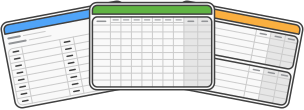
A simple table works:
| Task | Start Time | End Time | Duration | Break | Notes |
|---|---|---|---|---|---|
This helps you track patterns and refine your workflow.
4. Be honest about interruptions
If something pulls your attention away—note it.
Was it:
- Internal (boredom, urge to check phone)?
- External (email, colleague, meeting)?
Understanding this helps you reduce interruptions over time.
5. Match tasks to energy
Use your highest energy periods for demanding work:
- Writing
- Strategy
- Deep thinking
Save lighter tasks for lower-energy periods.
When to use flowtime (& when not to)
The flowtime technique shines when:
- You’re working on large projects
- You need deep focus
- You want to avoid fatigued work
However, the pomodoro technique may still be better when:
- You struggle to begin
- Tasks feel overwhelming
- You need strict structure
In reality, many people create a hybrid system—a modified version that blends both approaches.
Common mistakes to avoid
1. Ignoring breaks
It’s tempting to push through, especially when things are going well.
But skipping break time reduces long-term productivity and limits recovery.
2. Multitasking
The entire system depends on focusing on one task.
Trying to juggle multiple tasks breaks the flow state.
3. Overtracking
While it’s important to track, don’t let it become a distraction.
Keep it simple.
4. Forcing focus
If you’re truly exhausted, don’t force another session.
Your ability to focus depends on proper rest.
Making flowtime a sustainable habit
Like any technique, consistency matters more than perfection.
To make it stick:
- Plan your day in advance
- Keep your to do list realistic
- Reflect on what worked
- Adjust your session length over time
This isn’t about squeezing more work into less time—it’s about working in a way that feels natural and effective.
The appeal of the flowtime technique is simple: it treats you like a human, not a machine.
Instead of forcing productivity through rigid systems, it allows your energy, attention, and natural rhythms to guide your work.
Some days, your sessions will be long and deeply focused. Other days, they’ll be shorter and more fragmented. That’s okay.
What matters is that you’re paying attention—learning how your focus works, adapting your workflow, and building a system that supports your real life, not an idealized version of it.
Whether you’re watching your progress improve over time, refining your process, or simply enjoying the feeling of being truly fully immersed in meaningful work, the flowtime method offers a flexible path toward sustained productivity.
And once you find your rhythm, you may never want to go back to the clock.